
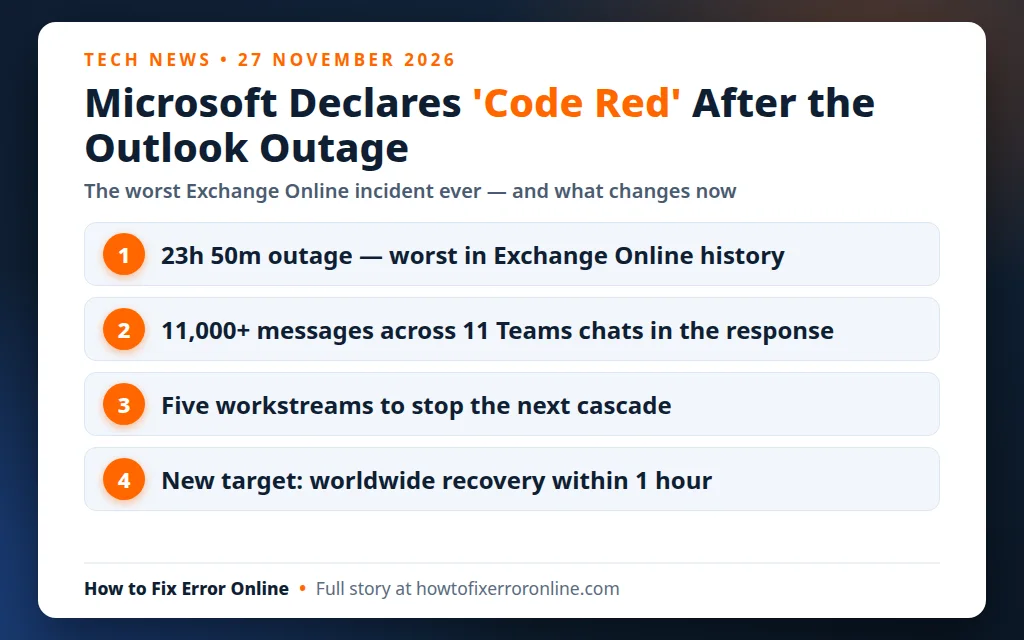
Microsoft Declares “Code Red” After the 24-Hour Outlook Outage — What It Means
November 27, 2026 — Microsoft has declared an internal “Code Red” after the global Outlook outage of November 12–13, 2026 — the worst incident in the history of its Exchange Online email service. The move, reported on November 24 from internal memos reviewed by Reuters, puts fixing how Microsoft prevents and responds to major outages at the top of its engineering agenda.
To be clear: this is not a new outage. Outlook, Teams and Copilot were restored on November 13. Code Red is about what happens next time.
What “Code Red” means
“Code Red means that this is the highest priority work for our team,” Jason Henderson, president of Microsoft 365 Core, wrote in a staff memo on Friday, November 20.
It is an internal designation, not a customer alert. Nothing in the reported memos changes Microsoft’s service levels or contracts. But inside the company it is the strongest signal available: reliability work now outranks everything else.
Why Microsoft acted
Henderson called the November 12–13 outage the most customer-impacting incident in Exchange Online’s history, saying the company had never before seen so many customers lose email access for so long.
The numbers explain why. The outage ran for 23 hours 50 minutes, from 16:20 UTC on November 12 to 16:10 UTC on November 13, and at its worst more than 80% of Microsoft’s 365 gateway servers had stopped responding. Downdetector recorded roughly 130,000 Outlook problem reports at the peak. Microsoft’s final post-incident report (November 20) traced the failure to a Windows scalability defect introduced in July 2026 that went undetected for months — not a cyberattack, and not AI. Read the full timeline and causes in our Microsoft Outlook outage report.
The response itself struggled
The memos also show Microsoft’s own recovery effort had problems. Engineers exchanged more than 11,000 messages across 11 separate Teams chats while trying to fix the outage, and Amanda Silver, a Microsoft corporate vice president overseeing Microsoft 365 Core, described the response as a “fog of war” — diagnostic data was scattered across internal tracking systems, so teams struggled to keep a single picture of what was wrong.
At a Code Red review, Charles Lamanna, Microsoft’s executive vice president for Copilot, Agents and Platform, said the failed component had accumulated “roughly ten years’ worth of acceptable failures.”
What Microsoft promises to change
Under Code Red, Microsoft is working on five areas: shedding excess load when servers fail, splitting traffic by geography so a failure cannot cascade across regions, recovering services faster, deploying urgent fixes worldwide more quickly, and using AI agents to help engineers diagnose problems faster.
The headline commitment is a one-hour target: worldwide recovery within an hour for future major incidents, and critical security fixes deployed globally within an hour. Henderson noted that in a separate recent incident, an urgent production fix took five to six days to reach every region. He will hold daily meetings with the leadership of Substrate, the engineering layer behind Microsoft 365, with weekly progress reviews. Microsoft CEO Satya Nadella has publicly apologised for the disruption.
What this means for you
Nothing changes for Outlook users today — the service is running normally, and no action is needed. The value of Code Red is for the next incident: whether Microsoft can keep a future failure to an hour instead of a day. That is a promise to judge by results, not by memos, and we will update this story as the fixes land.
If Outlook is still misbehaving for you after the outage, first check whether anything is still down on Microsoft’s side, then work through the recovery steps.
Sources: Reuters reporting on internal Microsoft memos (24 November 2026), as covered by Times of India, The Verge, Mac Observer, Silicon Republic and The Jerusalem Post; Microsoft’s final post-incident report EX1550543 / MO1550821 (20 November 2026), as covered in our outage report.